

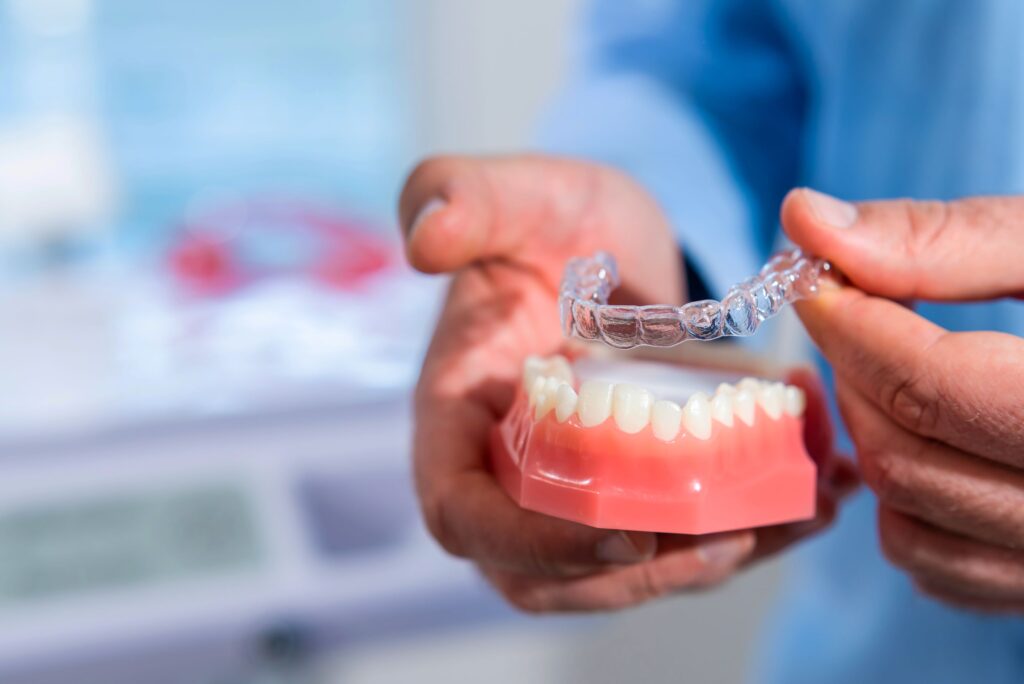
Invisalign continues to gain popularity as a more comfortable and discreet solution than traditional braces. Instead of utilizing metallic brackets and wires, this treatment relies on transparent plastic trays that fit snugly over your teeth to gently shift them to their ideal places.
But many patients wonder whether this service can successfully address other concerns, too, such as an overbite, underbite, or other malocclusion. If you’re curious whether these trays can help improve your bite alignment, continue reading to learn more about it!
How Does Invisalign Work?
Many people opt for Invisalign to avoid the frustration of standard orthodontics. Unlike the sharp corners of brackets and the clipped ends of wires, the smooth plastic material is unlikely to cut or gouge the tender tissues of your mouth. Instead, the smooth trays snap into place over your arches, exerting enough pressure to shift your teeth more comfortably.
But you must wear the aligners for 20 to 22 hours daily to prevent them from reverting to their starting places. Then, after about a week or two, you’ll be instructed to switch to the next ones in your series to account for the ongoing movement of your smile.
What are Invisalign Buttons or Attachments?
Invisalign initially was intended to address more minor concerns, like mildly gapped or overcrowded teeth, meaning that patients with more severe issues would likely require traditional braces instead. However, today your dentist can include buttons to help make this treatment more effective.
These attachments typically involve strategically placing a small amount of clear or tooth-colored composite resin directly onto your enamel to serve as an additional anchor for your aligners. This improves their grip, enabling them to address more complex issues than before.
Can Invisalign Address Bite Misalignments?
Although historically many dentists still relied on braces for malocclusions, like overbites or crossbites, today your provider may be able to address these issues with Invisalign instead. By including attachments or bands, your dentist may be able to use these trays to address the following concerns:
- Overbite. This refers to when your upper arch juts too far beyond the lower one, which can lead to injuries or premature wear on the back of your enamel.
- Underbite. If your top teeth rest inside the bottom ones when you bite down, you may have this condition.
- Crossbite. This occurs when some of your upper teeth sit inside the lower ones in certain areas when you close your mouth.
- Open bite. If your teeth don’t come together correctly when you bite down, you may have this condition.
If you’re unsure whether Invisalign can help straighten your smile, your dentist can examine your condition and devise an appropriate treatment plan to meet your unique needs!
About the Practice
Patients at Harrisonburg Family and Cosmetic Dentistry benefit from two dentists eager to help people of all ages build and maintain beautiful, healthy teeth and gums. Dr. DeNicola and Dr. Khanna collaborate to provide a complete menu of services, including Invisalign, conveniently under one roof. Their office is equipped with state-of-the-art technology to improve patient comfort while delivering more accurate treatment results intended to last. If you’re concerned about a bite misalignment, you can request an appointment on the website or call (540) 432-6616.